Communicating Hygiene and Health with the Bacteria Germs Minimal Infographic
In the realm of public health education, corporate safety training, and medical marketing, clarity is paramount. Complex biological concepts often fail to resonate with general audiences when presented through dense text or overly realistic, sometimes unsettling, microscopic photography. This is where the Bacteria Germs Minimal Infographic serves as a critical communication bridge. By utilizing clean lines, simplified shapes, and intuitive iconography, this visual resource transforms abstract threats into understandable, actionable information. For professionals tasked with educating adults on hygiene protocols, illness prevention, or microbial science, adopting a minimal design approach is not merely an aesthetic choice; it is a strategic necessity for effective knowledge transfer.
Overcoming Visual Fatigue and Misinformation
Adult learners and general audiences face significant challenges when consuming health-related content. The primary obstacle is often cognitive overload. When individuals are presented with hyper-realistic images of pathogens or cluttered diagrams, the emotional response can range from disgust to anxiety, which actively hinders learning. Furthermore, in an era of information saturation, audiences have developed a blindness to generic stock imagery. A standard photo of a person washing hands may no longer trigger the necessary behavioral reminder because it has become visual white noise.
The goal for educators, designers, and health communicators is to create materials that are instantly recognizable, emotionally neutral, and scientifically accurate without being overwhelming. There is a distinct need for resources that balance professional credibility with approachability. Whether the objective is to reduce workplace sick days, improve patient compliance with post-operative care, or explain the difference between viral and bacterial infections to students, the visual language must be precise. The Bacteria Germs Minimal Infographic addresses these specific pain points by stripping away non-essential details and focusing entirely on the functional representation of germs, transmission vectors, and preventive measures.
How Minimalist Vector Design Enhances Understanding
The efficacy of the Bacteria Germs Minimal Infographic lies in its adherence to semiotic principles. Linear pictograms and flat illustrations allow the viewer to process information faster than they could with complex raster images. When a user encounters a stylized representation of unhealthy teeth or dirty hands, the brain categorizes it immediately as a symbol representing a concept rather than a specific instance of decay or filth. This abstraction creates a psychological distance that makes the topic safer to engage with while retaining the urgency of the message.
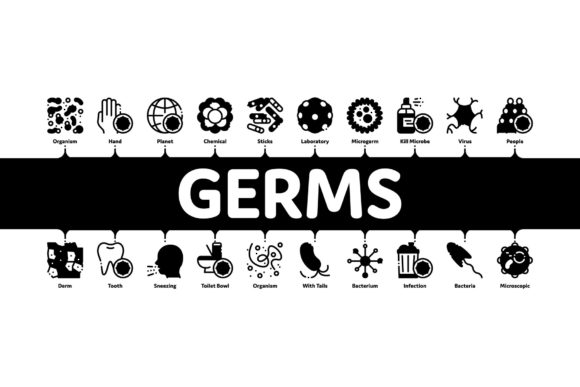
Furthermore, the inclusion of specific character archetypes, such as a sternutation character (sneezing figure) or illness people with germs, provides narrative context without requiring lengthy explanations. These linear pictograms act as universal signifiers. In a multicultural environment or a multilingual healthcare setting, these minimal visuals transcend language barriers. They communicate "cover your mouth," "wash your hands," or "stay home if sick" more effectively than translated text alone. The minimalist style ensures that these symbols remain legible even when scaled down for mobile screens or printed on small signage, maintaining their utility across various media formats.
Practical Applications Across Industries
The versatility of this infographic collection allows it to be deployed in numerous high-stakes environments. Understanding how to leverage these assets can significantly improve outcomes in health communication.
- Corporate Wellness and Safety: HR departments and safety officers can utilize the microbe types illustration to differentiate between bacteria, viruses, and fungi during flu season briefings. Using the web banner vector format, companies can create consistent internal newsletters or intranet headers that remind employees of hygiene standards without inducing panic. The clean aesthetic aligns with modern corporate branding, making safety feel like part of the culture rather than a regulatory burden.
- Healthcare and Patient Education: Dental clinics can use the unhealthy tooth pictograms to explain periodontal disease progression. Because the imagery is minimal and diagrammatic, patients are less likely to feel defensive or embarrassed about their oral health status. Similarly, pediatricians and general practitioners can use the bacteria germs minimal infographic elements to create take-home cards that explain antibiotic stewardship, visually distinguishing when medication is appropriate versus when rest is the better solution.
- Educational Materials and E-Learning: Instructional designers creating courses on biology or public health benefit immensely from the EPS file format. Vectors allow for infinite scalability and color customization to match course themes. Educators can isolate specific elements, such as a single bacterium or a hand-washing sequence, to build interactive modules. The consistency of the linear pictogram style helps maintain visual coherence throughout a curriculum, aiding in memory retention.
- Public Health Campaigns: Government agencies and NGOs require visuals that work on everything from billboards to social media tiles. The sternutation character and germ illustrations are designed for high impact at low resolution. In digital campaigns, these minimal graphics load quickly and remain clear on small devices, ensuring that vital health messaging reaches users regardless of their connection speed or device quality.
Leveraging File Formats for Maximum Utility
To fully realize the benefits of the Bacteria Germs Minimal Infographic, users must understand the technical advantages of the provided file formats. The availability of both EPS and JPG files caters to different stages of the production workflow and varying levels of design expertise.
The EPS (Encapsulated PostScript) format is the industry standard for vector graphics. For graphic designers and marketers, this is the most valuable asset. It allows for the manipulation of individual anchor points and paths. If a brand uses a specific shade of teal, the designer can recolor the entire microbe types illustration set to match perfectly within minutes. EPS files also support transparency and layering, enabling the creation of composite images where germs appear behind text or interact with other branded elements. This format ensures that whether the graphic is printed on a business card or a building wrap, the edges remain crisp and professional.
Conversely, the JPG format serves immediate implementation needs. For office managers, teachers, or healthcare administrators who do not have access to Adobe Illustrator or similar vector software, the JPG provides a ready-to-use solution. These rasterized versions are optimized for insertion into Word documents, PowerPoint presentations, and email bodies. While they lack the editability of the EPS, they offer convenience and compatibility. Having both formats included in the package ensures that the resource is accessible to both creative professionals and administrative staff, democratizing access to high-quality health visuals.
Tailoring the Approach to User Needs
Different stakeholders will approach the Bacteria Germs Minimal Infographic with distinct objectives, and successful implementation requires adapting the visuals to those specific goals. A scientist communicating with peers might prioritize the accuracy of the microbe types illustration, ensuring that the morphological differences between cocci, bacilli, and spirilla are respected even in a minimal style. Their focus is on precision within simplicity.
In contrast, a marketing manager for a hand sanitizer brand will prioritize emotional resonance and brand alignment. They might select only the dirty hands and clean hands pictograms, discarding the scientific classifications entirely. Their goal is behavioral activation, not academic instruction. They will likely modify the line weight and color palette to evoke feelings of freshness and safety rather than clinical sterility.
Educators fall somewhere in between. They need the scientific accuracy of the former but the engagement strategies of the latter. When using the illness people with germs pictograms, a teacher might combine them with real-world data or case studies. The minimal infographic acts as the anchor—the familiar visual hook—upon which deeper, more complex lessons are hung. By recognizing these differing approaches, users can avoid the common mistake of using the same visual strategy for every audience. The flexibility of the Bacteria Germs Minimal Infographic supports this nuanced application, provided the user takes the time to select and adapt the right elements for their specific context.
Moving Toward Clearer Health Communication
Ultimately, the value of resources like the Bacteria Germs Minimal Infographic extends beyond their immediate utility in design projects. They represent a shift toward more empathetic, user-centered health communication. By choosing minimal, linear pictograms over shock tactics or dense jargon, communicators demonstrate respect for their audience’s time, intelligence, and emotional well-being. Whether utilized as a comprehensive web banner or broken down into individual icons for a checklist, these visuals empower adults to make informed decisions about their health. In a world where misinformation spreads as quickly as pathogens, having access to clear, accurate, and adaptable visual tools is an essential component of any effective health literacy strategy. Investing in high-quality vector assets is an investment in the clarity and effectiveness of your message, ensuring that when it comes to health and safety, nothing gets lost in translation.