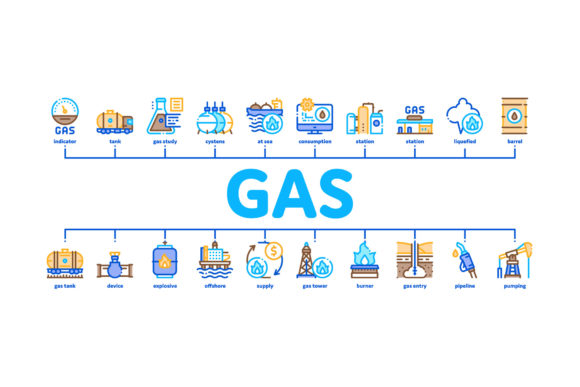
Gas Fuel Industry Minimal Infographic Design Guide
Communicating complex energy logistics requires a balance between technical accuracy and visual clarity. The Gas Fuel Industry Minimal Infographic serves as a specialized visual framework designed to bridge this gap for professionals in the energy sector. Rather than relying on dense text or cluttered photography, this design approach utilizes clean lines, standardized iconography, and strategic negative space to convey information about gas truck cargo delivery, carriage transportation, stations, and derricks. For marketers, educators, and industry stakeholders, adopting this minimal aesthetic is not merely a stylistic choice but a functional strategy to enhance data comprehension and audience retention.
Streamlining Complex Logistics Communication
The primary value of a Gas Fuel Industry Minimal Infographic lies in its ability to distill intricate supply chain processes into digestible visual narratives. In the oil and gas sector, stakeholders often need to explain the journey of fuel from extraction to end-user delivery. A realistic photograph of a derrick or a gas truck can be visually noisy, containing irrelevant background details that distract from the core message. By utilizing vector-based illustrations of flames, barrels, and transport vehicles, designers can isolate specific variables.
Consider a safety training module for new logistics coordinators. Using a minimal infographic allows the instructor to highlight specific valve checkpoints on a carriage transportation diagram without the visual interference of rust, weather conditions, or unrelated machinery found in site photography. This abstraction forces the viewer to focus on the process flow rather than the environment. The result is faster cognitive processing and higher retention of safety protocols. When the visual noise is removed, the operational logic becomes the sole focus, making these assets indispensable for internal documentation and standard operating procedure (SOP) manuals.
Technical Versatility Through EPS and JPG Formats
Professionals selecting these assets must understand the practical distinction between the available file formats. The inclusion of both EPS and JPG files addresses two distinct workflows common in industrial marketing and operations. The EPS (Encapsulated PostScript) format is a vector-based file that retains mathematical precision regardless of scale. This is critical for large-format printing, such as trade show banners, facility signage, or detailed engineering schematics. Because the Gas Fuel Industry Minimal Infographic elements are vector-based, a derrick illustration can be scaled to the size of a billboard without pixelation or loss of edge definition.
Conversely, the JPG format serves immediate digital needs. While raster-based and resolution-dependent, JPGs are universally compatible with web platforms, email newsletters, and presentation software like PowerPoint or Keynote. For a blogger writing about energy trends or a small business owner updating their service page, the JPG provides a ready-to-use asset that requires no specialized vector editing software. Understanding when to deploy each format ensures efficiency; use EPS for print production and brand asset libraries, and utilize JPG for rapid digital communication and social media engagement.
Enhancing Web Presence with Dedicated Banner Vectors
Digital first impressions in the B2B energy sector often suffer from generic stock imagery. The Gas Fuel Industry Minimal Infographic Web Banner Vector offers a targeted solution for establishing immediate topical relevance. Unlike general industrial vectors, these banners are pre-composed with horizontal aspect ratios suitable for website headers, LinkedIn articles, and digital advertising. They integrate key semantic symbols—flames representing combustion or energy, barrels indicating storage capacity, and trucks signifying logistics—into a cohesive header layout.
For entrepreneurs and freelancers building portfolios or agency sites, these banners reduce design time significantly. Instead of composing individual icons and worrying about alignment, color consistency, and whitespace, the user deploys a professionally balanced composition. This consistency helps build brand authority. When a visitor lands on a page regarding natural gas transport and immediately sees a clean, relevant banner featuring accurate carriage transportation iconography, trust increases. The minimal style also ensures that overlay text remains legible, a common failure point in busy photographic banners where contrast ratios fluctuate unpredictably.
Strategic Applications Across Professional Roles
Different professionals derive unique benefits from these specific visual assets based on their distinct operational goals. Marketers and content creators benefit most from the semantic clarity of the flame and barrel illustrations. These symbols act as visual shorthand, allowing audiences to categorize content instantly before reading a single word. In an era of short attention spans, this rapid recognition is vital for reducing bounce rates and improving click-through metrics on energy-related content.
Educators and trainers find value in the modular nature of the gas truck and station illustrations. Training materials often require updates as regulations change. With vector assets, an instructor can swap out a tanker truck for a rail carriage illustration without redesigning the entire slide deck. This modularity supports agile curriculum development. Small business owners and consultants, who may lack dedicated design teams, benefit from the professional polish these assets provide. Using consistent, high-quality minimal graphics elevates proposals and reports, signaling competence and attention to detail that rivals larger competitors.
Navigating Limitations and Selection Criteria
While the Gas Fuel Industry Minimal Infographic is a powerful tool, it is not universally appropriate for every context. Users must recognize where minimalism fails. If the goal is to showcase the physical condition of equipment for maintenance verification or insurance assessment, abstract illustrations are insufficient. Real-world photography is required to document wear, corrosion, or specific mechanical configurations. Minimal infographics represent idealized states; they communicate concepts, not current realities.
Furthermore, buyers should verify the specificity of the illustrations against their niche requirements. "Gas fuel" encompasses upstream exploration, midstream transport, and downstream retail. A generic barrel icon may suffice for a general energy blog, but a technical report on LNG (Liquefied Natural Gas) cryogenic transport requires specialized tank illustrations, not standard oil drums. Before acquisition, review the asset pack to ensure the derrick types, truck configurations, and station layouts align with the specific segment of the industry being addressed. Mismatched iconography can undermine credibility with expert audiences who notice technical inaccuracies immediately.
Optimizing Visual Hierarchy for Data Retention
Effective use of these assets extends beyond simply placing them on a page. To maximize the utility of the Gas Fuel Industry Minimal Infographic, users should apply principles of visual hierarchy. The minimal style relies heavily on weight and spacing to guide the eye. When integrating gas truck cargo delivery illustrations into a report, ensure adequate padding surrounds the graphic. Crowding these elements with text negates the benefits of the minimal aesthetic and creates cognitive load.
Color coding within the vector files offers another layer of utility. Many EPS files allow for easy recoloring. Establishing a consistent color logic—for example, using blue for natural gas streams and orange for hazardous zones—across all infographics creates a unified visual language. Over time, stakeholders learn to interpret these colors intuitively, speeding up decision-making during presentations or emergency response planning. This systematic approach transforms isolated graphics into a comprehensive communication system, leveraging the simplicity of the minimal style to manage the complexity of the gas fuel industry.